Most conversations with us start with one of these.
Pick the one closest to what's actually on your desk. We'd rather spend the first call on your problem than on our product.
{{ item.q }}
{{ item.teaser }}
{{ item.labelText }} ▾
{{ item.more }}
{{ item.linkText }} →Same infrastructure. A different moment of decision.
You keep your sensors, your SCADA, your lab. What changes is what happens in the moment something starts to shift, and what you're able to show afterward.
No more waiting for the next round
Continuous water-quality signal replaces the gap between scheduled lab samples, so a shift in conditions doesn't sit unnoticed for days.
Not every blip needs a response
A signal move triggers physical autosampling automatically, confirming the event before it becomes an intervention, a call, or a report.
A decision you can stand behind later
Signal and sample sit alongside your own SCADA, GIS, and lab data, so what you did, and why, is documented as it happens, not reconstructed after.
As we observe your network over time, this layer will build a causal understanding of its behaviour: earlier warning when something is developing, and a recommended action attached to it, not another number to interpret yourself.
The cost of not knowing what's in the water between samples.
A single contamination event, caught by regulatory sampling rather than before it, runs into the tens of millions once response, compensation, and enforcement are counted. Continuous visibility closes the gap between samples, with no capital outlay and a two-week install. We laid out the full economics, the enforcement exposure by jurisdiction, and the evidence, with sources.
In a controlled study, our sensor ran the full length of a staged sewage-intrusion test that flow cytometry, the reference method it was tested against, didn't finish.
In a controlled testbed operated by Sweden Water Research, our sensor was run alongside flow cytometry against a staged sewage-intrusion event. Both methods were measured on the same water, at the same time, under the same conditions.
Sewage intrusion detected at dilution
The sensor detected the intrusion event at dilutions between 0.17% and 0.33% in the Sweden Water Research testbed.
Ran for the full length of the test
Flow cytometry stopped partway through; our sensor operated without interruption for the full duration.
Faster return to baseline after the event
After the intrusion cleared, the sensor recovered to its pre-event baseline faster than flow cytometry did.
Controlled testbed, Sweden Water Research. Detection method built on peer-reviewed tryptophan-like fluorescence literature: Stedmon 2011; Khamis 2015; Sorensen 2015, 2018, 2021.
Results describe what was measured in that testbed. They are not a performance guarantee for any other network.
The Water Council’s Spring Tech Challenge, 2026.
The challenge sought AI-native technologies for water systems. Aqua Alarm was selected for the $10,000 prize by the program sponsors, Badger Meter, Watts Water Technologies, and Xylem. Announced 3 June 2026.
Tech Challenge spotlight, The Water Council →A layer that sits on top of what's already running, instead of replacing it.
Every one of these stays exactly where it is. Aqua Insights reads alongside them.
Most of the utilities we talk to have already done the math on what one avoided compliance event is worth, or what a few points off reactive operating cost would mean. We'd rather understand where it actually applies on your network than make that case in the abstract.
The same gap shows up anywhere continuous water-quality visibility matters.
Our commercial focus today is regulated drinking-water utilities. The same sense, confirm, decide logic applies more broadly, and these are the adjacent markets we're exploring.
Greywater and non-potable networks
Reuse and greywater systems carry their own water-quality risk profile, and face the same gap between periodic testing and continuous operational visibility as drinking-water distribution.
Deliberate and accidental contamination
Frameworks that classify water infrastructure as critical raise the same requirement drinking-water utilities already face: continuous visibility, not periodic compliance sampling alone.
Hospitals, government buildings, hotels, police stations
High-consequence sites depend on internal water systems where a contamination event carries an outsized cost. The same detection and decision logic applies at building scale.
Process and dual-use infrastructure
Operators managing both process water and adjacent critical infrastructure face comparable visibility gaps to municipal utilities, with their own risk and compliance context.
These verticals are not part of what we deliver today. If one of them is closer to your situation than drinking water, tell us, and we'll be straightforward about where we actually stand.
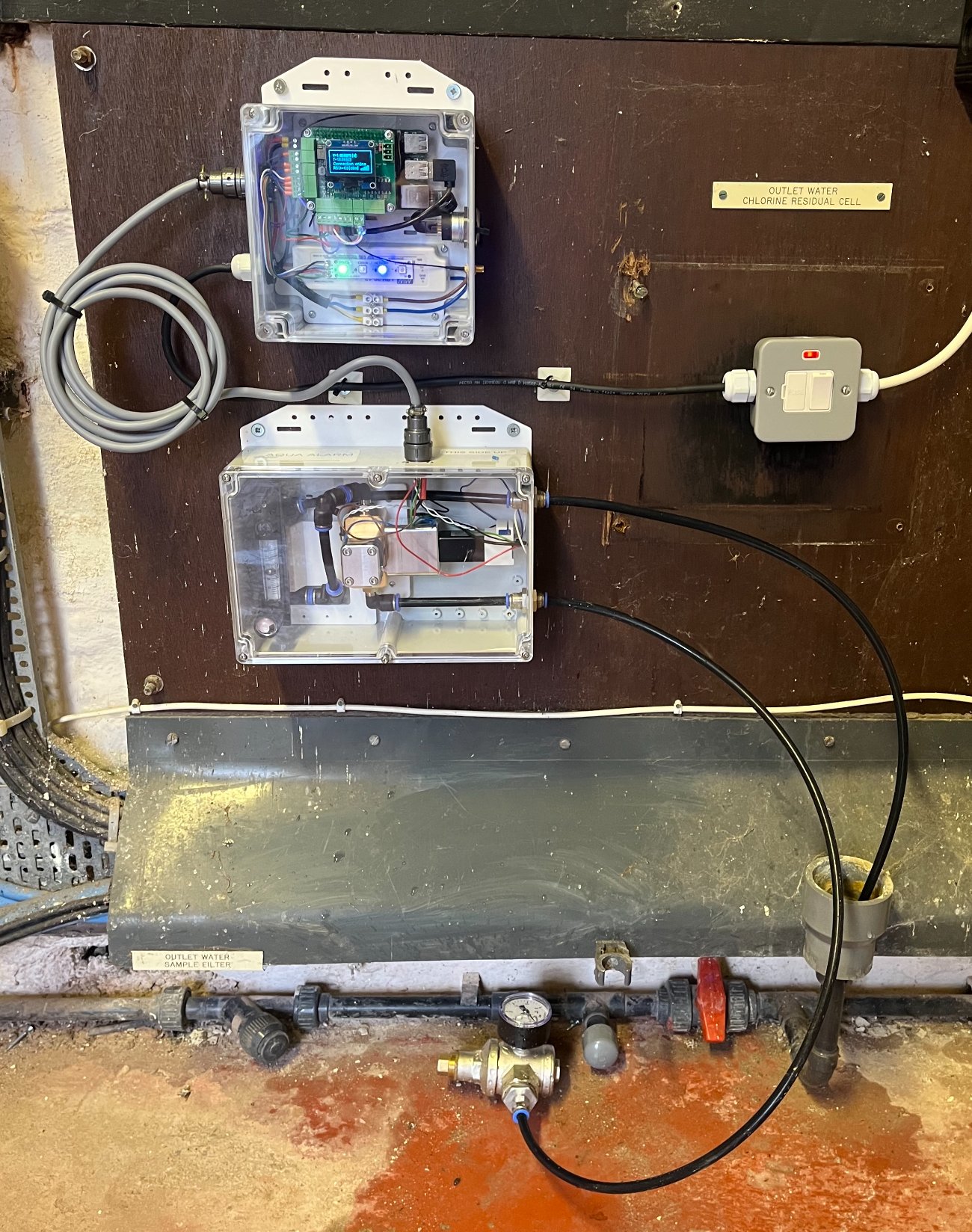
What a completed deployment actually looked like.
Our sensors operated inside live utility infrastructure, not just a lab bench. They were exposed to seasonal change, pressure events, network interventions, and weather, and produced real production data throughout the deployment period.
The understanding that came from that time in the field could not have come from a controlled test environment. It carries forward into every network we deploy next.
See what this can look like in your network — request a demo →Aqua Alarm is a Norwegian deep-tech company building the operational intelligence layer for water networks. The team combines water science, causal AI, and utility operations experience.
Tell us what's on your desk right now.
This is a short, informal conversation about the risk you're managing and where the actual gaps are. We'll take it from there.
The fastest way to reach us is directly. Tell us what's on your desk, in your own words, and we'll take it from there.
{{ emailDisplay }}